
RigorMed
Research resources
Guides to literature searches, data analysis, and academic writing, with medical research examples.Method guides
24 guidesHow to verify medical citations: PMID, DOI, retractions and claim support
Connect a sentence to the paper it cites: Citation-checking records, a claim-to-source mapping table and a list of missing evidence.
Read guidePrepare a 10-minute journal club: from paper to eight-slide speaker notes
A source-linked PACE-UP example for planning eight journal-club slides: timing, denominators, effects, limitations, figure attribution, an AI task request and review checks.
Read guideHow should Table 1 be prepared for a medical paper?
What belongs in a medical paper's Table 1? Check counts, denominators, missing data and the limits of P values, with an example layout and an adaptable AI request.
Read guideHow to read a forest plot: effect sizes, 95% confidence intervals and pooled results
Turn a forest plot into an evidence-based results interpretation: An effect-measure checking table, an interpretation draft and a list of unresolved questions.
Read guideHow to hand over a reproducible research analysis package
Connect input versions, execution order, environment and expected outputs in a reviewable handoff. Distinguish complete files, an actual rerun and a scientifically valid conclusion.
Read guideHow to build a literature evidence table: link outcome definitions and results to sources
Create a traceable table from authorized reports: study–report links, outcome windows, denominators and source locations. Includes an adaptable AI task, a synthetic output excerpt and human checks, not a meta-analysis or model run.
Read guideEditing an abstract with AI without changing numbers, negation or claims
A synthetic before-and-after abstract and a locked-facts table show how to prepare materials, edit sentence by sentence and review changes. Includes a complete suggested request; fluent prose is not semantic certification.
Read guideHow should a medical manuscript be checked before submission?
Turn a pre-submission read-through into an itemised revision list: A manuscript checking table with source locations, revision suggestions and questions for the authors to confirm.
Read guideHow to complete a STROBE checklist: map manuscript locations and reporting gaps
Build an item-to-passage crosswalk from an authorised manuscript and an applicable STROBE checklist. Includes a synthetic table and a complete AI request without inventing methods, funding or results.
Read guideHow to report missing data: variable counts, analysis samples and assumptions
Missingness percentages do not choose a method. Check variable counts, overlapping missingness and model samples with a synthetic example and an adaptable AI request.
Read guideHow should medical research data be cleaned?
Start by making cleaning actions into a reviewable rules table: A cleaning-rules table, a quality-issue summary and a change-log template.
Read guidePreparing a graphical abstract: ask AI for a verifiable design brief first
Turn lawful manuscript material into a source-linked content table, layout brief and caption draft. Check design, effect units and provenance; use a teaching output excerpt and respect journal AI-image policies.
Read guideDrafting a medical research plan with AI: inputs, outputs and tool choice
A labelled teaching task shows how to turn an idea into a research question, variable definitions, a plan paragraph and a gap list, with guidance on choosing an AI workflow.
Read guideTime zero in retrospective cohort studies: aligning eligibility, exposure and follow-up
Turn unclear timing definitions into a plan paragraph for discussion: A study-timing definitions table, a time-zero plan paragraph and a question list.
Read guideHow to choose a journal for a medical paper: scope, article type and author requirements
Organise candidate journals into a comparable submission-conditions table: A candidate-journal conditions table, reasons for current mismatches and a materials checklist.
Read guideWhat research can NHANES support?
Turn a broad NHANES direction into a topic-preparation brief: A topic-preparation table, variable and cycle requirements, and a research-question draft.
Read guideHow should NHANES data files be merged?
Write merge rules as a reviewable file-handoff brief: Merge-rule documentation, a component-matching checking table and a sample-flow record draft.
Read guideHow to choose NHANES survey weights
Organise a weighting question into a pre-analysis decision record: A table of weighting evidence, a complex-sampling design draft and items for statistical review.
Read guideHow to verify NHANES variables
Turn a variable list into a traceable data-dictionary draft: A source-linked data-dictionary draft, a cross-cycle differences table and a field-gap list.
Read guideHow to report participant flow in an observational study
Turn selection records into a flow-diagram drawing brief: A flow-node and count checking table, drawing instructions and a caption draft.
Read guideHow to start medical research using public databases
Develop a research direction into a reviewable data-source comparison: A candidate-source comparison table, a materials checklist and a narrowed research question.
Read guideIs your public-data research topic feasible?
Turn “can this topic be done?” into a feasibility memo: A feasibility memo, a gap list and a research-plan discussion draft.
Read guideHow should a PubMed search query be written?
Turn a medical question into an editable query and search record: A query draft and a concepts and synonyms table; a search record is compiled only after an actual test search.
Read guideHow to select studies for a systematic review: deduplication and PRISMA flow
Organise selection decisions into a reviewable PRISMA count table: A selection-ledger structure, a PRISMA count-checking table and items awaiting adjudication.
Read guideResearch examples
2 guides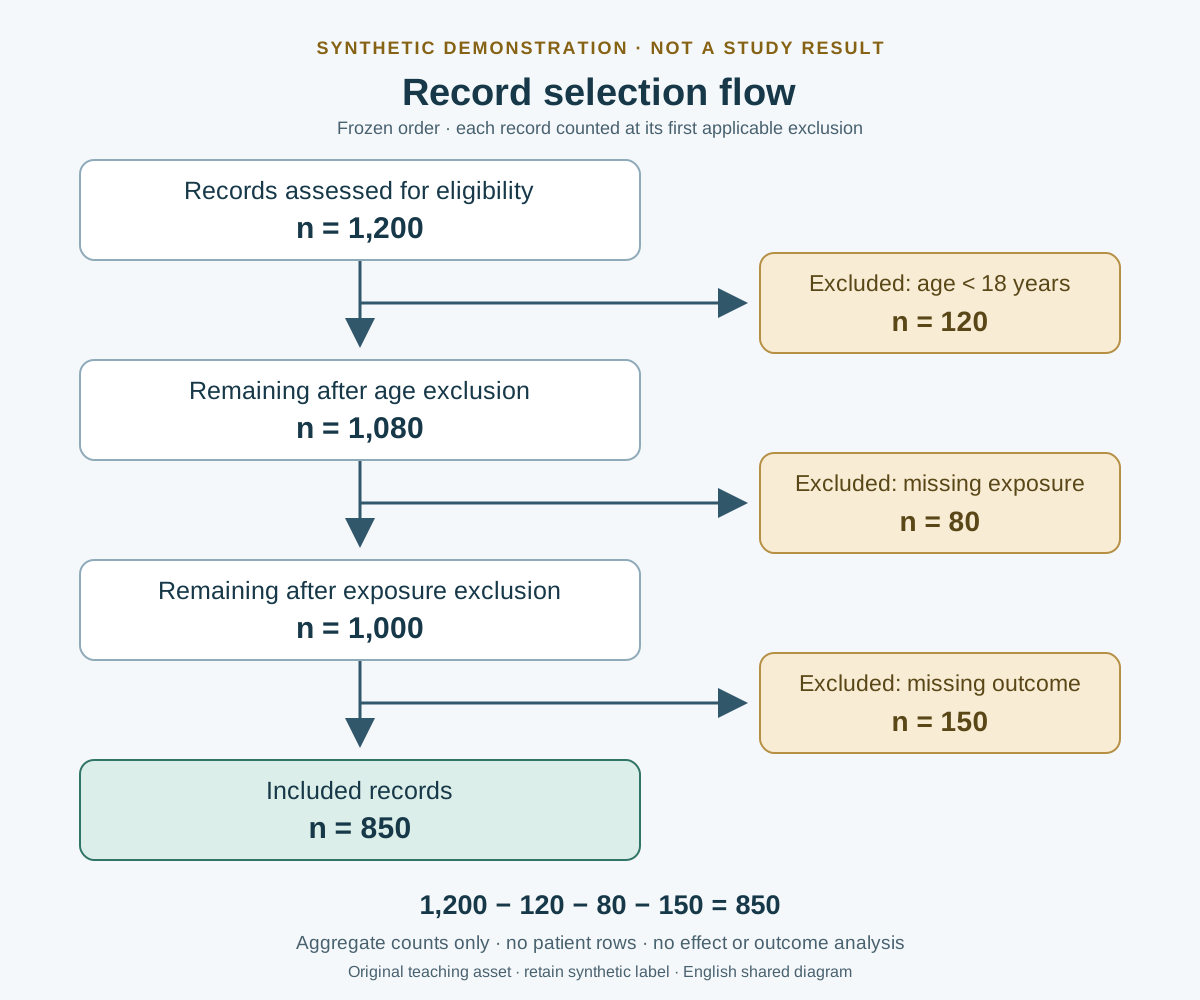
How do selection counts become an inspectable research flow diagram?
A complete selection-flow example using explicitly synthetic aggregate counts: 1200 assessed records become 850 included records. Download the CSV, methods and figure legend, and editable SVG. This is not a study finding or model run.
Read guide
Has blood pressure control changed among cancer survivors?
Using public NHANES 2015–2018 and 2021–2023 data, compare changes in uncontrolled blood pressure prevalence between cancer survivors and people without cancer among US adults receiving antihypertensive treatment.
Read guide